EDM artist Mr. Carmack talks about cultural expressions, coming from multiple nationalities, the land that was once before – and his upcoming release “Deluge”
By Katharina Moser

A bright clear sun blazes down from a candy-blue sky for the first time in days, dunking San Francisco and its bay in bright, cheerful light. Its decisive rays have defeated and drawn away the stubborn grey fog that had veiled the metropolis and created the perfect conditions for this September Sunday. On the roof top of the Cavaña, seventeen stories above ground, bodies sway in the speckles of sun light, glasses clink for an early-day Tequila, and a beat comes from a DJ desk built up on the terrace of the roof top, echoes between the skyscrapers and travels all the way down to the streets where people pour into the lobby of the hotel leading up to the Cavaña. Behind the mixing desk stands no one less than Mr. Carmack, the EDM artist and wavemaker who has shaken up the international DJ industry for years, and who is about to turn this Sunday into a memorable day of music and dance.
“I started making music as a kid”, he reveals two days later, in the backyard of his San Francisco home. From a self-made artist and producer in home-grown recording rooms to stages like Coachella and Lollapaloosa, the 35-year-old artist from the Bay has come a long way. “My dad is a pianist and a singer, and my mother is a Japanese Taiko drummer. Throughout school, I played in bands, learned various instruments and played French horn in the orchestra”, he says. As a teenager, he started to make electronic music – long before it was part of the American mainstream. “I was introduced to electronic and techno music through my older cousins. Back then, people would call you gay for listening to it”, he recalls with a grin. “And then it broke the American market.” From its druggy underground roots, electronic dance music made it big in the US in the 2010s. Grossing millions of dollars and DJ artists commanding rock-star fees, the scene was reborn as what The Guardian back then titled “the bombastic super-spectacle”. And Mr. Carmack delved right in.
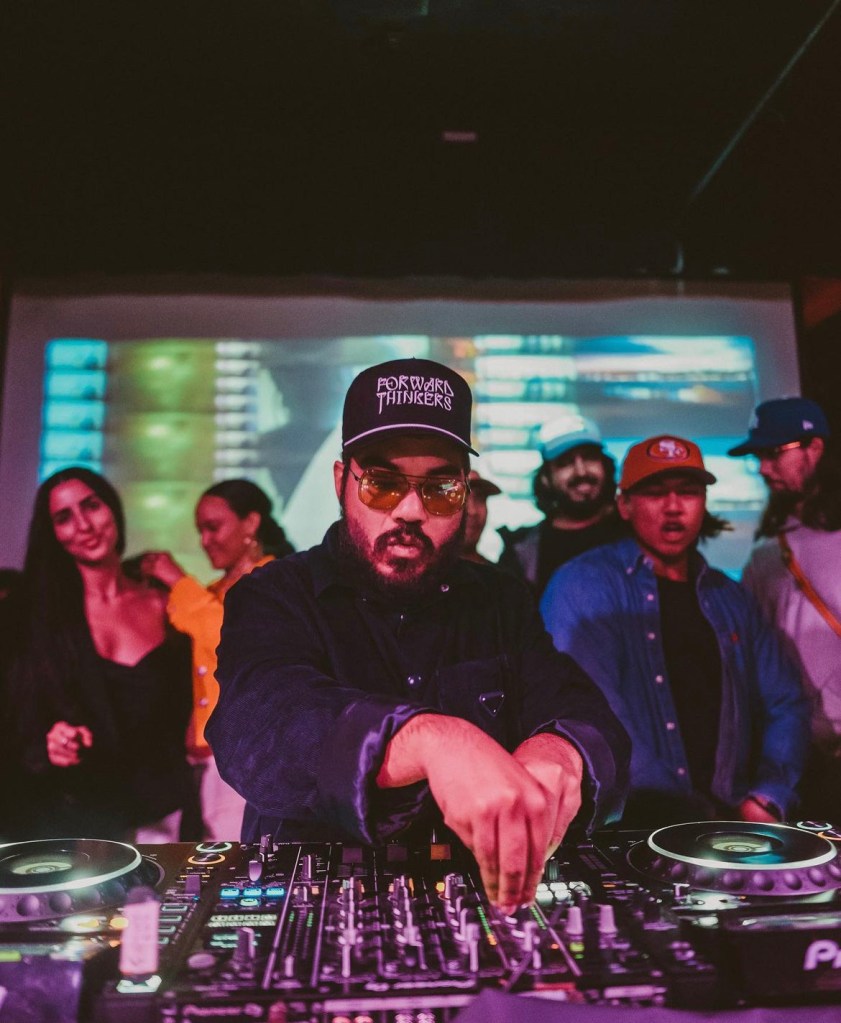
In his early twenties, a young Mr. Carmack dropped out of college to pursue his dream as an artist and DJ. Since then, he has contributed tremendously to the evolvement and refinition of the prolific genre. “For a while, I was going to school just because it was what I was supposed to do, to please my family. But then there came a moment of realization that this is not what I want to do with my life. I decided to go full force with music”, Mr. Carmack says. He dropped out, worked at restaurants and bars during the day and made music at night, working himself up the ladder in the music industry. “That took an active decision. Humans are one-track minds. You need to do what you are meant to do. Sometimes it takes a certain delusion, where everybody else wonders what the fuck you are even doing. At a certain point it manifests itself. And then people start to recognize you.”
After twenty years of making and recording music, Mr. Carmack´s style remains outside of conventional categories and their oversimplifications. While most of his electronic music can be regarded as trap – a mix of electronic dance music and hip hop – he has also done instrumental live shows or even jazz versions of his electronic music. “I write music all the time, every day. But to define me in terms of genres is an issue. I cannot be pinpointed to one side”, Mr. Carmack ponders. At a Carmack show, fans often expect his heavier EDM beats – and sometimes get surprised by a trumpet melody instead. “As I’m getting older, my music tastes change, too”, he says. His shows usually reflect that in their arc of suspense. “I like to start with instrumental or more relaxed songs and after that, I give them what they want – my trademark heavy EDM beats.”

As his versatile music style is an accumulation of various sounds and genres that escapes clear boundaries and limitations, his persona, too, is an amalgam of diverse identities and cultures that cross over and merge and ultimately fall into place to make him who he is – a human being who is at home in more than one place, and who is able to craft this into his fabric of expression effortlessly, his ultimate superpower. Mr. Carmack belongs to the Native community, as his mother is part Tohono O’odham and part Filipino. His father, in turn, is a Hawaiian native. Does his Native American heritage shape how he thinks about music and what it is supposed to do to people? “Yes and no. It is part of who I am, but I’m not constantly thinking about my Nativeness.” Mr. Carmack is convinced that his Native identity does not have a major effect on his musical style, that it is not inherently Native American music. Yet, he decided to bring out his long-time friend and mentor Edwardo Madril, member of the Yaqui community and appraised dancer, out for his performance at Coachella in 2016, dressed in all-white Native regalia and performing Native American dances to the beat of his songs – to represent the Indigeneity, the Native essence of his artistic identity. “He has always played the role of an elder to me, and I look up to him. It was not about the façade of relevance, it was about him and me sharing a bond on stage as two performers”, he says. “To have a Native American dancer during my set at Coachella was a yearning to discover more about myself through us being in the same space.” Mr. Carmack does not consider his music Native in any particular way – yet, his beats and styles are in constant conversation with all the various cultures that inform his identity and personhood.
In that sense, Mr. Carmack’s music is as much not Native American – as it does not actively engage Native American music traditions – as it is Native, as music being created by a Native American maker. Native does not only describe a locality. “More importantly, it is a cultural term, meaning that it belongs in the canon. My music could be understood as a descendant or offspring of the shaker music and powwow music of Native American tradition. But I’m not sure if that relation is exactly right, because my music is an amalgamation of a lot of things. I descend from seven nationalities. I could not possibly represent all of them in the same intensity.” While Mr. Carmack does not know much Native music and does not speak his Native language, he says, Hawaiian culture, on the other hand, has shaped him extensively. Would he like to consider his music Native in any sense? “It doesn’t matter. My music is my own”, Mr. Carmack says, and smiles. “Some people think I’m Black, some people think I’m white, some others think I’m Asian, some even think I’m Mexican.” He laughs. “I’m the hinge on the center of a long, long web of identifiers that people have consolidated for themselves.” In truth, his music is the expression of a multiverse of identities, and ultimately of the fact that music does not rely on or confine itself to any of these categories. And that his story is knit not by a singular, but an abundance of narrative threads. “I just make music, man”, Mr. Carmack smiles. And this music is everything at once – all that he comes from and all that he is, all narratives embedded in one story, a reflection of the complex inner world of an artist.

Mr. Carmack’s family is Filipino and Hawaiian, Chinese, Native American, and Irish. “All of them make me who I am. And of course, I am American. I always call myself American. But does that include my Nativeness? The land that was once before? Probably not. It probably includes the McDonald’s down the road, though”, he says, and laughs. Born in San Francisco, he spent the last few years living in Los Angeles. Now he is back in his hometown – and happy about it, too. He has bought the house his parents live in, is busy renovating and building his own studio in the basement.
What is the most important advice he ever got? Mr. Carmack thinks for a moment. “Don’t be a dick!” He grins. “A lot of people take an air to themselves, an air of superiority when they become halfway successful with whatever they do”, he clarifies. “Being back in San Francisco, in this house, I feel like I’m on level one again. My point is: Always be humble, be open to learn.” For Mr. Carmack, it is all about the people, the respect, the thoughtfulness and the consideration for those around him.
Amidst all that, Mr. Carmack is going to keep writing and making music, all day and every day, in a constant process of becoming and unbecoming in a web of the stories of his people and their culture. His next series of releases is already planned – an album series called “Deluge”, with the first part due at the end of the year. “My parents are hoarders. If I open any of the doors in my house, there is boxes over boxes of stuff. Deluge, in turn, alludes to the great flood story that is part of many belief systems around the world. So far, I have not put together an effective body of work. This album is about this idea of releasing a flood, the process of opening up your files, opening all those boxes”, Mr. Carmack relays with a smile. “The flood gates open, and you’re gonna get hit with a bunch of music, a flow that won’t stop.”
 The Wrapper